

Delicate, Devotional and Distinctive: Why Are Quaker Needlework Samplers So Valuable?
No Content Set
Exception:
Website.Models.ViewModels.Blocks.PageBlocks.BillboardBlocks.InlineBillboardBlockVm
10th August 2026
Our 9th September Collectors Auction will feature four important Quaker needlework samplers. Ahead of the auction, we delve into the history of this distinctive needlework tradition and explore the question: why are Quaker samplers so collectable?
A Brief History of Quakerism in Britain
Quakerism, known officially as the Religious Society of Friends, is a Christian religious movement founded in the mid-17th century by George Fox, a spiritually dissatisfied shoemaker's apprentice turned theologian. Quakerism emerged during the turbulent period of the English Civil War, amid a wider wave of religious dissent and separatism from the Church of England. These groups became aptly and collectively known as the Dissenters.
As Quakerism grew, some of the wealthiest and most influential families in England became Quakers. This was partly due to the Quaker tenet of frugality and partly because of the close commercial networks created through shared worship and community connections. Families such as the Cadburys, famous for chocolate, and the Lloyds and Barclays, associated with banking, were prominent Quaker families.
These prosperous Quaker communities required schools that reflected their religious principles, including simplicity, discipline, education and plain living. Among the most notable was Ackworth School, founded by John Fothergill in 1779. It was at these schools where the distinctive tradition of Quaker needlework developed.

The Origins and Style of Quaker Needlework Samplers
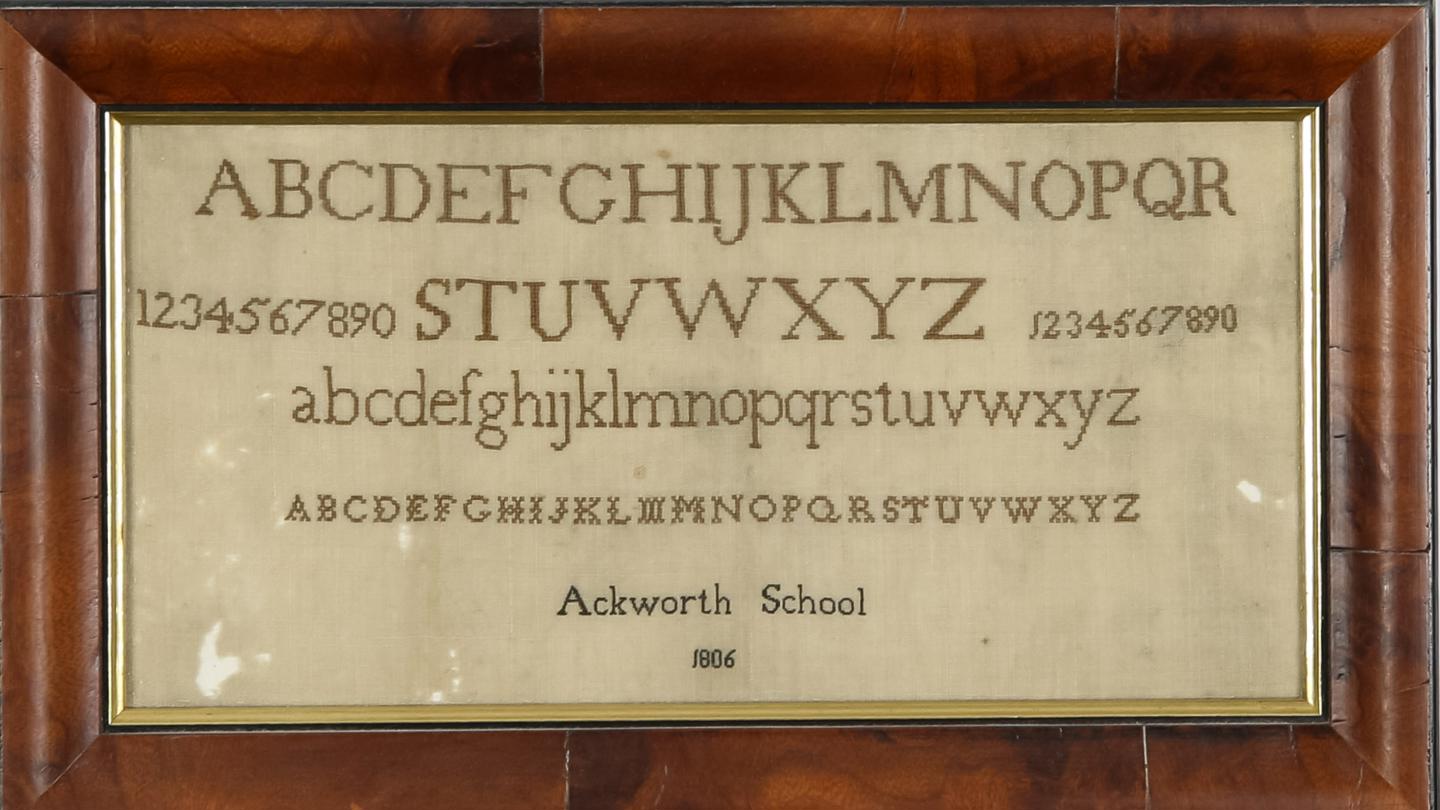
Quaker needlework was viewed as rigorous discipline and developed as part of the school sewing curriculum, where girls embroidered identifying symbols onto household and school linens. These symbols often took the form of simple yet highly refined lines of numbers or alphabetic characters.
The samplers themselves were worked on finely woven, plain linen, typically using a single shade of thread. Unlike the traditional schoolgirl sampler, you will not find stylised scenes of idyllic landscapes, bouquets of flowers or charming animals. Instead, Quaker embroidery placed its emphasis on precision, featuring only devotional words, religious texts and moral instruction that reflected the Quaker ideals of simplicity and plainness.
Ironically, the Quaker rejection of excessive ornament and overt forms of personal display created one of the most recognisable styles of British needlework. Today, Quaker samplers are valued as important examples of folk art, textile history and religious material culture. Their extremely accurate, restrained aesthetic has proved particularly appealing to collectors, especially in the American market.
A sampler becomes especially desirable when it records the maker's name, date and school of origin, providing a rare insight into both its creator and the history of Quaker education. Such details can transform a simple piece of needlework into a highly personal historical document, and can have a significant impact on its desirability and value at auction.
Important Quaker Schools
As one of the earliest Quaker schools in Britain, Ackworth School samplers are particularly sought-after by collectors. During the late 18th century, the distinctive Ackworth “medallion” style began to emerge and mature, featuring embroidered passages from the Psalms, longer extracts from the Bible, and other moral and everyday lessons. An example by Margaret Alderson, included in our 9th September Collectors Auction, is offered with an estimate of £500–700.
The tradition of Quaker sampler-making was further established by the foundation of later Quaker schools, including Trinity Lane School in York in 1785 and Milverton School in Somerset. Together, these schools helped sustain the distinctive tradition of Quaker needlework and sampler embroidery, which continued to flourish for the following seventy years.

Quaker Samplers as Collectable Antiques
The tradition of Quaker needlework began to decline during the mid-19th century. As Quakers gained greater religious freedom and social acceptance, children increasingly attended schools outside the traditional Quaker educational network. This weakened the institutional environment in which Quaker sampler-making had flourished.
Although the tradition of making Quaker samplers declined, many examples have survived in museums, private collections and the antiques market. Today, antique Quaker samplers are important sources for the study of Quaker religious culture and education.
Significant collections can be found in institutions including the Fitzwilliam Museum, the British Museum and the Victoria and Albert Museum (V&A). In the United States, collections at Winterthur and Philadelphiaprovide further important examples of Quaker needlework and sampler traditions.
Want to know the value of your textile collection? Speak to our Specialists.
Sign up for Catalogue Alerts
Be the first to know about when our auction catalogues, upcoming valuation days and latest auction insights